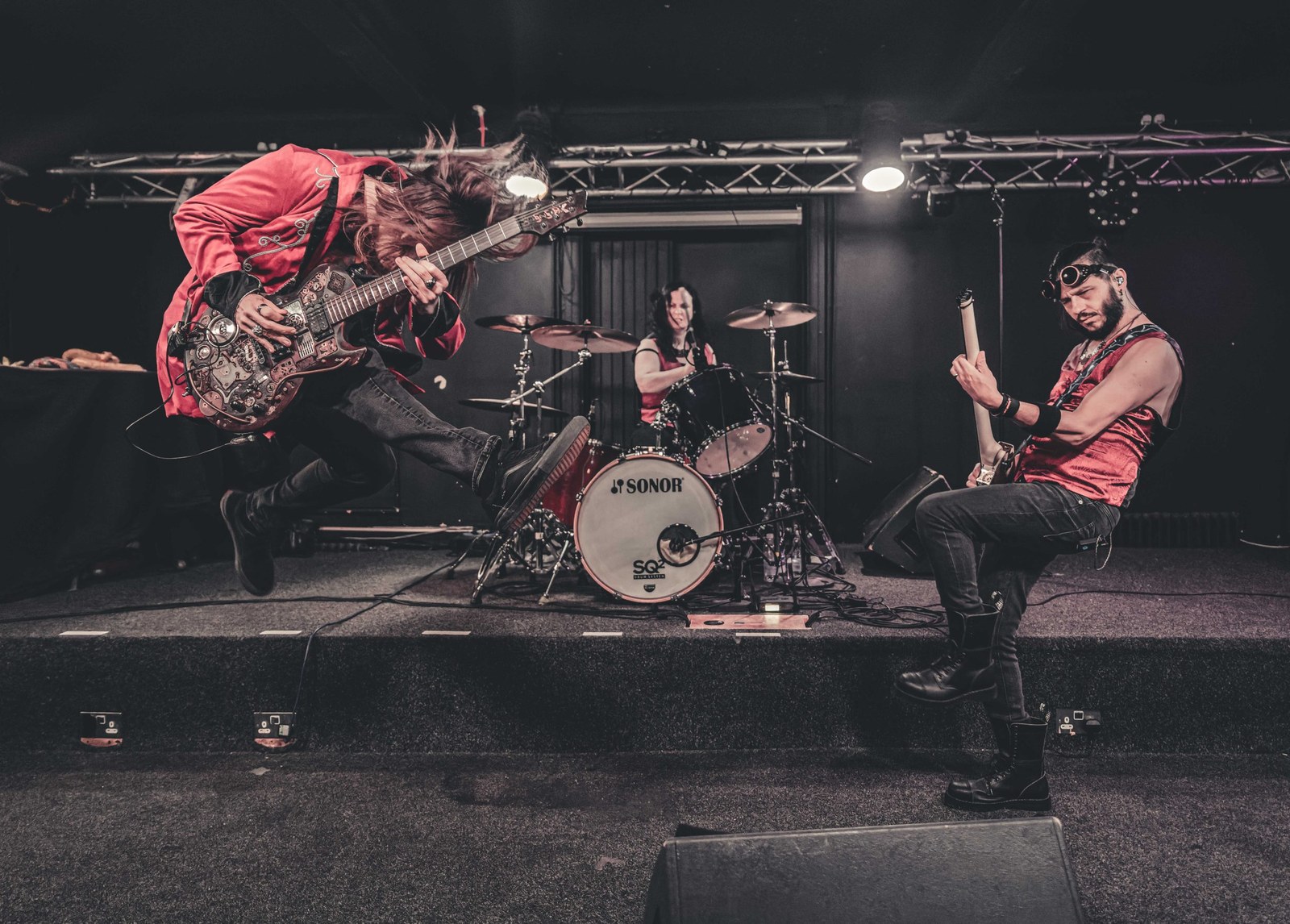
Spinors are a steampunk alternative rock band based in London, founded by singer and guitarist Sergie Code. They are six months old and have already played more than twenty shows across the UK. ‘You Loved The Cage’ was written in Europe and recorded in Buenos Aires with Nawe on drums and Santi on bass, then mixed and mastered by Nico Resnikof at Romaphonic Studios. The video was shot in Lincoln and London with people from the community around Asylum, one of the biggest steampunk events in the world. We were really happy when Sergie agreed to chat to us.
‘You Loved the Cage’ turns on a hard idea: that a person can get attached to the thing keeping them small. Where did that come from?
It comes from a collection of experiences I’ve had over the years, moments where I found myself, or people around me, holding on to something that clearly wasn’t doing us any good. There’s a strange comfort in the familiar, even when the familiar is hurting you. A toxic relationship, an addiction, a life that’s going nowhere: they all become a kind of home, and leaving home is frightening even when the door’s wide open. In the song, the cage is a metaphor for exactly that. Two people get through a very dark period together, and their love grows out of those circumstances. The painful question is what happens when the circumstances change. If the bars were part of what held you together, what’s left once they’re gone? I used fiction to take all of that to the extreme, because it gives me enough distance to explore it properly, and it leaves room for listeners to bring their own cages into the story.
There’s a strange comfort in the familiar, even when the familiar is hurting you.
There’s a great video for this one, and it’s loads of fun. What did you want someone to see that the song on its own doesn’t give them?
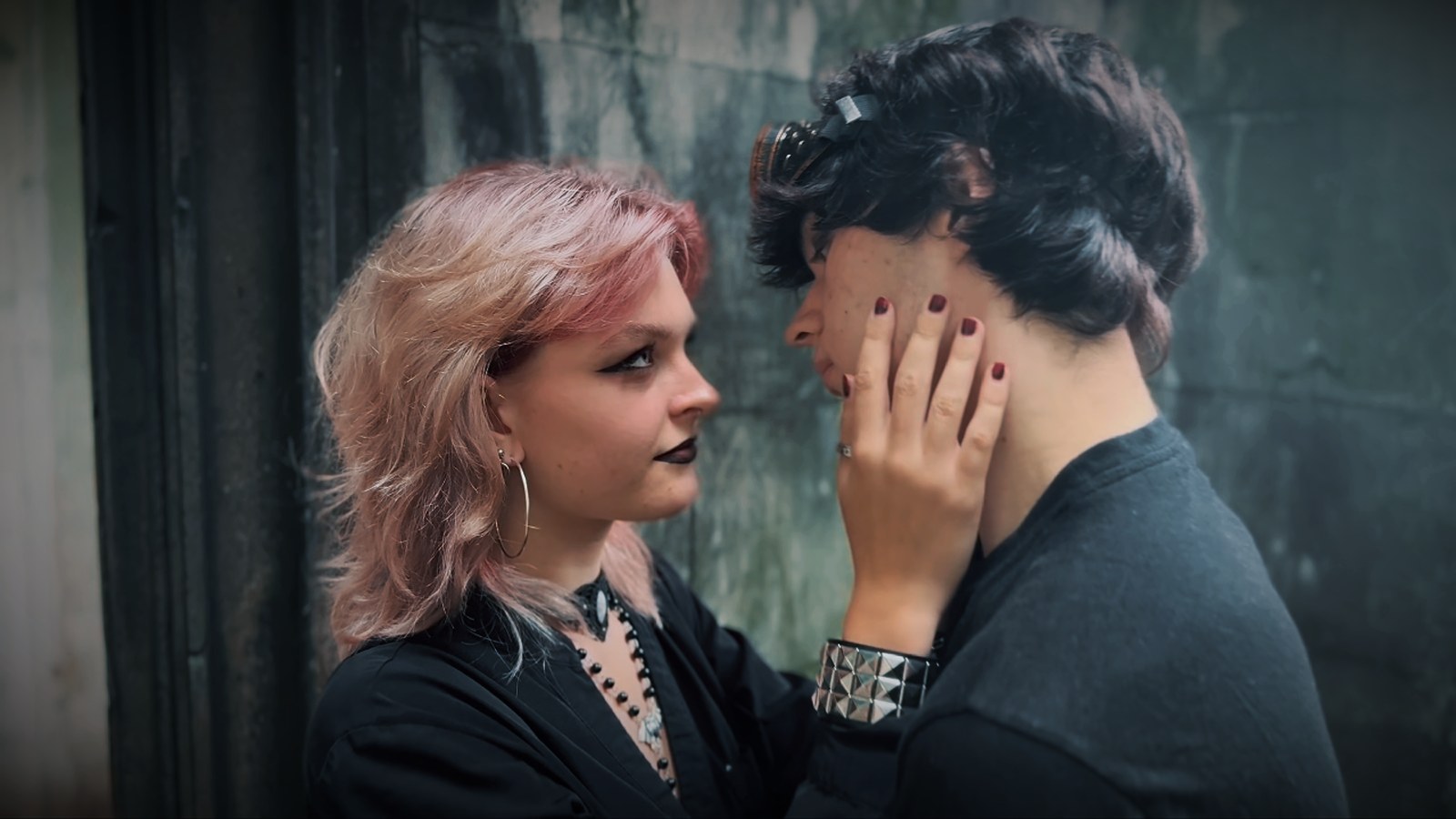
Thank you, we had a brilliant time making it! The song only gives you one side: the narrator, heartbroken and convinced they’ve been abandoned. The video gives you the other side. We see that both of them were trapped in addiction. He fights his way out and chooses a different life, while she relapses. Suddenly the “villain” of the song doesn’t look like a villain at all. Then, right at the end, he gets involved with his therapist, which makes you wonder whether he’s really free or has just swapped one cage for another. Around them there’s a whole fantasy world. Deadline, the girl with the Kubrick stare, is a demon living inside their minds. The Countess represents experience and maturity, and a plague doctor drifts through it all. We shot it in Lincoln and London with wonderful people from the community around Asylum, one of the biggest steampunk events in the world, and they brought so much heart to it. We filmed far more than fits into four minutes, so we’ll be sharing extra scenes on social media to keep the story going.
You combine a heavier sound with a keen sense of melody. What were some of your earliest musical inspirations?
I love bringing together elements of very different natures, and it all starts with a feeling. Before I write a single word, I decide what emotion, idea or situation the song needs to convey, and then I gather every element that makes me feel it. From there, it’s a lot of hard work to shape all those pieces into one song. My rule is that the music has to make me feel what I set out to express before the lyrics even exist. With “You Loved the Cage”, that meant heartbreak, betrayal, confinement and disappointment, so every musical choice had to pull me into that place of a toxic love story. The heavy riffs and catchy choruses are simply part of how I write. I adore 70s riffs and 90s choruses, and although I listen to a million different genres, those are the elements that make me feel most alive when I’m playing them on stage. That’s the heart of Spinors: something that hits hard, with a chorus you can sing at the top of your lungs.
As for my earliest inspirations, I started out singing in choirs as a child, everything from Argentine folk music to gospel, and as a teenager I was obsessed with Guns N’ Roses and The Doors. But the real turning point came with 90s grunge and punk. Most of my friends gravitated towards the male voices of that era, like Kurt Cobain and Eddie Vedder. For me, the most fascinating voices belonged to the women: Courtney Love, Brody Dalle, Kat Bjelland, Donita Sparks and many others. There was something so raw, fearless and unpredictable about the way they sang, and that has stayed with me ever since.
You named the band after a thing in particle physics and then dressed it up in steampunk. Isn’t that a nightmare to explain at a family dinner?
Ha! My family stopped being surprised a long time ago. I’ve loved steampunk since I was a child, I work as a software engineer, and I’m always reading science books to keep up with what’s new, so being the family nerd is nothing new for me. The one who really struggled was my Polish grandmother. She emigrated to Argentina to escape the war, and she simply couldn’t understand my taste in music. She did her best to steer me towards opera and classical music instead. It’s not what dominates my Spotify, but I’m genuinely grateful she did, because I love going to the theatre to hear it live. As for the name: a spinor is a quantum property that stays undefined until someone observes it. To me, that’s exactly what a song is. It only takes shape when someone listens and brings their own memories and experiences to it. Quantum physics, music and steampunk are my three great passions, so rather than choose between them, I brought them together. I like to think my grandmother would have approved of the Victorian outfits, at least!
It only takes shape when someone listens and brings their own memories and experiences to it.
Argentina to London is a big move. Does ‘You Loved the Cage’ sound to you like a song written there, or one written about there?
Funnily enough, neither! I wrote it entirely in Europe while I was travelling between different countries. It draws on experiences from across my whole life, though, and because it’s such an introspective song, I don’t think where I was writing it mattered much. Leaving everything behind has definitely shaped other songs, like our first single “Walk Alone”, but this one looks inwards rather than at any particular place. Argentina does play a big part in how it sounds, because I flew back to Buenos Aires specifically to record it. I have world-class musicians there who are also close friends: Nawe on drums and Santi on bass. They know me inside out and understand exactly the sound I’m after. It was mixed and mastered by Nico Resnikof at Romaphonic Studios, one of the best studios in the country. Recording there also made sense financially, which matters a lot for an independent band. So I’d say it’s a song written in Europe and brought to life in Argentina.
Now it lives here, and we’re so grateful for how it’s being received. We’re only six months old as a band, and we’ve already played over 20 shows across the UK. We’ve been added to some lovely alternative rock playlists around the world, and we’ve passed 8,000 streams on Spotify and 12,000 views on YouTube. Seeing people in the crowd wearing our T-shirts when we come back to play near a town we’ve visited before still feels unreal!
But honestly, the most powerful thing music has ever given me, in my previous bands and in this one, is the connection with people. And even though Spinors is so young, something happened while making this video that means more to me than any number. After filming, Sandra, who plays the Countess, sent me a message thanking me for the opportunity. She told me it took her back to her days as a rocker, and that both she and a friend of hers who took part in a wheelchair had enjoyed it enormously, because chances like this hardly ever come their way. Then there was Evie, our youngest cast member, who plays Deadline. Her mum told me Evie had been going through a really tough time with a difficult family situation, and that being part of the video had helped lift her out of a very dark period. She ended up with a much bigger role than we’d planned, because she has incredible presence on camera, and I’m certain she’s going to be a wonderful artist. Moments like these are what make me want to give everything to this career.
Six months old, more than twenty shows in, and already making a video that meant something to the people standing in it. ‘You Loved The Cage’ is out now, and it is worth watching the whole way through.
Keep an eye on Spinors. We will be.