This edition of Acoustic BOPS celebrates raw feeling and timeless melody. From French art-rock warmth to Canadian lo-fi introspection, these two artists remind us that acoustic music can still hit with emotional precision.
Dan Szyller – Smile of Beauty
Dan Szyller captures the fragile connection between love and longing, wrapping emotion in melody with effortless grace
Recorded in Moselle, France, Smile of Beauty is a rich, heartfelt reflection on love and the passage of time. Drawing influence from The Doors, Pink Floyd, and Iron Maiden, Dan Szyller brings a cinematic sensibility to acoustic storytelling. His voice glides between nostalgia and yearning, tracing the contours of memory and connection.
Produced by Yannick Horner, the track’s warmth lies in its simplicity – shimmering guitars, subtle percussion, and a vocal performance that feels both timeless and immediate. There’s a poetic patience to Szyller’s delivery, as if each lyric holds a quiet truth.
It’s the kind of song that fills a space not with sound, but with feeling, lingering long after its final chord. Beautiful.
Scott’s Tees – We Move As Fast As Storms Allow
Scott’s Tees finds beauty in imperfection, crafting lo-fi intimacy that feels both fragile and fearless
From a small bedroom studio in Edmonton, Canada, We Move As Fast As Storms Allow captures the quiet electricity of dreaming alone. We love the Tascam-vibes and raw production, Scott’s Tees builds a world of hushed vocals and soft distortion, where each note feels importnat.
Influenced by Pearl Jam, Soundgarden, and Iron & Wine, the song drifts between alt-rock edge and folk tenderness. It’s a meditation on movement, memory, and the slow rhythm of growth, wrapped in a chorus that shimmers with haunting harmonies.
This is DIY at its most human – honest, unpolished, and resonant. The kind of song that asks for silence, then rewards it.
Follow Acoustic BOPS to hear these artists. Want to send us your music? Click here
This edition of Indie Folk BOPS steps into the forest with Roxy Rawson, whose haunting new single I Found A Place In The Woods turns grief into something incredibly luminous
Roxy Rawson – I Found A Place In The Woods
Roxy Rawson captures the quiet transformation that happens when pain meets beauty, and both decide to stay
With I Found A Place In The Woods, chamber-folk artist Roxy Rawson creates an atmosphere that feels like autumn breathing – fragile and fleeting, yet full of light. Her voice, described as “beautifully peculiar” and “brilliant” by the Independent on Sunday and BBC’s Tom Robinson, drifts through strings and piano like wind through leaves. The production by composer Jherek Bischoff wraps it all in cinematic stillness, balancing elegance with emotional clarity.
Inspired by the fairytale The Three Ravens, the track reflects on loss, self-discovery, and the renewal that follows heartbreak. Its companion hand-drawn video by Anna Maria Lesevic deepens the spell, tracing a journey from solitude to hope.
Rawson’s music bridges the classical and the personal, channeling her experiences of illness, recovery, and reconnection into something that feels timeless. I Found A Place In The Woods is both delicate and defiant, a quiet celebration of survival. It’s stunning, and we love it.
This edition of Dream Pop BOPS floats to New Brighton, where Aleutians deliver Osiris, a wistful burst of nostalgia that feels like the soundtrack to a half-remembered summer.
Aleutians – Osiris
“Aleutians capture the ache of small-town memories with cinematic warmth and heart.”
With Osiris, Aleutians turn everyday emotion into something quietly transcendent. The song shimmers with longing, the vocals hover somewhere between confession and comfort, and the melody feels suspended in sunlight. It’s a track built on simplicity and sentiment, shaped by the kind of honesty that lingers long after it ends.
Drawing influence from the likes of Turnover, Alvvays, and Death Cab for Cutie, Aleutians weave guitar pop with cinematic dreamscapes. Beneath the haze lies a writer’s touch for detail – love lost, moments replayed, the bittersweet calm of moving on. It’s music for anyone who’s ever feels nostalgia while life is still unfolding.
Osiris is both delicate and determined, a reminder that vulnerability can feel just as powerful as euphoria.
Aleutians make dream pop for open hearts and late nights, where memory and melody blur into something beautifully human.
This edition of Hip Hop BOPS lands in Melbourne, where multi-instrumentalist and producer Paul Louis Villani brings fire, funk, and fearless honesty with his latest track – a radio-ready remix that keeps its bite while turning up the bounce.
Paul Louis Villani bends funk, metal, and hip hop into something raw and electric. His music doesn’t just move, it provokes
On Sweat Drips, Villani channels his wild creative energy into something bold and immediate. The groove hits first – tight percussion, a pulsing bass line, and lyrics that dance between confidence and chaos. It’s a track that captures motion in real time, built for reels, radio, and restless bodies alike.
There’s a cheeky wink beneath the rhythm, a reminder that smart music can still move a crowd. Villani’s sound folds together funk, metal, and hip hop into something raw and electric, driven by instinct and experimentation rather than formula. Every word feels lived-in, every hit deliberate, and the whole thing pulses with his trademark humour and intensity.
Sweat Drips is more than a single – it’s a manifesto for unfiltered creativity. Villani doesn’t smooth the edges, he celebrates them, proving that authenticity can still sound dangerously catchy.
Paul Louis Villani brings art rock attitude to hip hop’s heart, and the result is pure, unstoppable groove.
This edition of Synthwave BOPS drifts through neon light and memory with Ervero’s cinematic release A Glitch in Time. It’s a masterclass in atmosphere, weaving 80s nostalgia with a modern emotional pulse that feels both expansive and intimate.
Ervero turns nostalgia into motion, blending cinematic warmth with a deep emotional gravity that pulls you in and never lets go
With A Glitch in Time, Norwegian producer Ervero builds a sonic world that bridges past and present. Vintage synth tones shimmer over a foundation of precise, heartfelt production, creating a sound that feels timeless yet vividly alive. Each layer carries intent, balancing analogue texture with digital clarity in a way that feels effortlessly natural.
It unfolds like a memory half-remembered, its melodies gliding between hope and restraint. Beneath the glowing synths lies a reflective core, exploring the tension between control and surrender, influence and independence. It’s as emotional as it is technical, proof that Ervero’s music is built as much from feeling as from design.
A Glitch in Time captures everything that makes modern synthwave endure: cinematic scope, emotional precision, and a sense of gravity that lingers long after the final note fades. Ervero proves that nostalgia doesn’t have to look backward. It can move forward, glowing brighter with every beat.
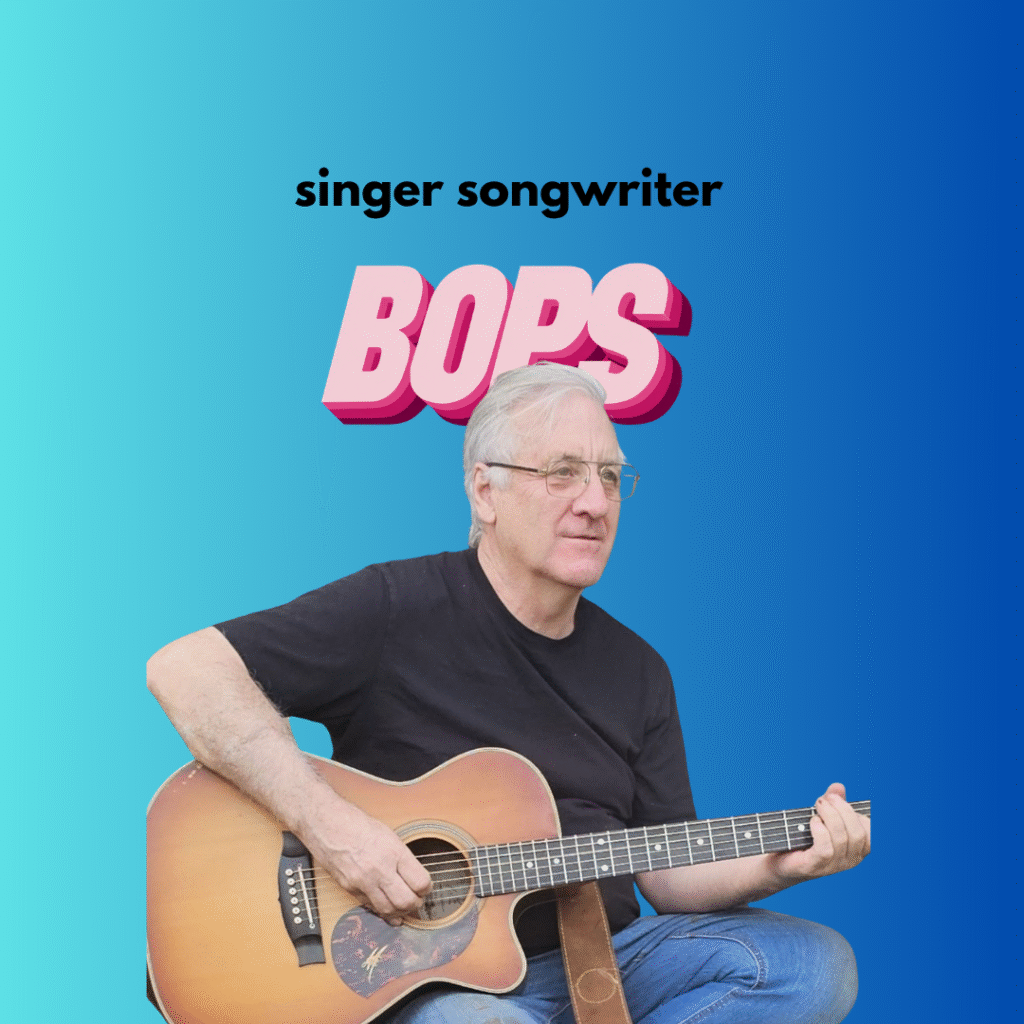
This edition of Singer-Songwriter BOPS drifts into the open skies of Australia with Mark Griffin’s heartfelt new release Taking Over My Mind. Warm, poetic, and quietly hopeful, it’s the sound of a storyteller finding beauty in life’s simplest turns.
Mark Griffin writes with the honesty of John Prine and the calm clarity of a sunrise. His songs remind us that ordinary days can hold extraordinary meaning
With Taking Over My Mind, Mark Griffin captures the charm of small moments and everyday reflections. The song feels both conversational and profound, offering a melodic sense of ease that’s rare in today’s songwriter landscape. Griffin’s voice carries a gentle sincerity, guided by Elliot Smith’s careful production and Max Brennan’s graceful instrumental touches.
What makes this track stand out is its lightness of touch. Beneath its simple acoustic framing lies a quiet emotional pull, a reminder that the best songs often come from lived experience rather than elaborate metaphor. The lyrics wander through snapshots of memory and gratitude, grounded in warmth and curiosity.
Currently a finalist in Australia’s national songwriting competition, Griffin proves himself as a writer with both vision and heart. Taking Over My Mind may be an understated release, but its message lingers: life’s best stories often unfold in stillness, not spectacle.
Mark Griffin turns simplicity into strength, delivering a song that feels as familiar as it is unforgettable.
Sean MacLeod, the Irish songwriter and composer, has long explored the space where melody meets meaning. His work balances introspection with craftsmanship, blending a classic sense of harmony with a quietly philosophical touch.
There’s a warmth and calm to his music that feels timeless. It speaks to connection and reflection, so we were so pleased when he agreed to chat to us at BOPS.
There’s definitely a real craft here with your songwriting. How do you balance instinct with thinking about the craft of a song?
That’s an interesting question. A song usually start with something instinctive or inspirational and, hopefully, I can put some shape on it. The thinking part usually is more to do with the structure. Usually, asking if I should start the song with a chorus or verse or does it need an intro or is it too long and should I cut something out. That aspect of the song-writing process has a lot more thought in it than the initial inspiration. Also, the lyrics tend to be something I often have to think about. Hopefully, if I get a good lyric that has an interesting turn of phrase I can use it as a hook, which again is usually more inspirational or instinctive than something I think about.
If I don’t have that initial lyrical inspiration the lyrics can be quite forced and usually they are no good but if I get that hook line usually the rest of the words come relatively easy- even if they require more thinking about.
When does music give you the most joy?
That’s another good question because a lot of people get the impression that creating music is a joy. To be honest creating music is really a lot of hard work. If you get a flash of inspiration that in itself fills me with a sense of joy and there is an excitement in that you have something to work on and try and shape into a song that other people might enjoy.
The spark of inspiration is really probably the most enjoyable part of the whole song writing process for me, after that, though, it’s often a hard graft to complete the song.
Sometimes, the song just flows and comes out pretty much fully formed but more often than not, I only receive the initial spark that needs a lot of nurturing and careful moulding into the finished song.
Arranging the song, I mean trying to write the parts for each instrument, takes a lot of concentration and then recording of the song after that is even more of a challenge because now I’m moving into the area of sound engineering, which is not really something I like doing.
Sound engineering is an art in itself. The final finished product is often enjoyable but it doesn’t last long because I’ve usually moved on to the next song. Actually, it’s quite nice to listen to the songs a year or so later when some distance has been created and you can hear it without all the baggage- like I’m just a fan of the music rather than its creator or something like that.
Beautiful Star feels like it was written from a place of peace. Do you remember the first moment it started to form?
Yes. I remember it very well because the song was born after a friend of mine had the grave misfortune of having their first child still born. They were living next door to me at the time and after they told me the news, I just sat down at the piano and that song came out pretty much all in one sitting. Most of the lyrics – definitely the chorus “We Don’t Even Know Your Name but We’re Glad You Came Along. We’re Heading for a Beautiful Star” came out in that initial sitting.
I guess it was my way of trying to rationalise what my friend and his partner were going through. My feeling is that the song itself didn’t have much to do with me – it was just given to me for some reason.
I’ve got the sense that your songs often carry a quiet philosophy. What kinds of questions or ideas keep coming back to you as a writer?
Yes. I think the same questions we all think about. What is this crazy world and life all about. Where did we come from and where are we going? Why do we suffer? why do we love? Universal questions that we are faced with every day. However, it often seems to me that modern western culture – particularly mainstream culture – tries to discourage people from thinking about these questions. It feels to me as if there is an attack on thinking.
You know, like the “don’t think, stupid!” culture of modern western life. We are being convinced that we should just be having “fun” and gratifying the self and not to bother with anything more. But, I think, the human spirit has a huge need to ask these bigger questions so its not so easy to completely supress it with all the bread and circuses. Obviously, it’s important to have a sense of humour and a sense of joy and fun in life otherwise it would be dull and to say the least unbearable. I like to use the fun aspect of pop music to explore or at least hint at these deeper questions that live within us all.
You’ve drawn from 70s pop and prog influences before – what do you like about that era’s sound that still speaks to you today?
I’m not overly influenced by 70s prog rock. My main influences come from the song writing styles of 60s British and American pop music, like the Beatles, the Beach Boys and Phil Spector. Those songs are really well crafted and have something to say and they have a great sense of joy about them too, however in my late teens I came across Bowie’s Hunky Dory album and I think that really influenced me in that Bowie really expanded the pop song into something that was more overtly philosophical in the lyrics while the music extended beyond the traditional 3 minute pop song. Songs like ‘Quicksand’ and ‘Oh You Pretty Things’ and even ‘Space Oddity’ really impressed me. Some of the ‘Space Oddity’ album was also similar in that regard – songs like “Memory of a Free Festival’. It was more those early Bowie albums from the late 60s, early 70s that I liked and had an impact on my own song-writing more so than the 70s prog rock scene.
It’s the joyfulness of the 60s music that still speaks to me. I think pop music should be fun as well as thoughtful. The innovativeness of the 60s left an impression on me.
Those records, I feel, really captured the newness and excitement of what they were discovering in their song writing craft, as well as all the new recording approaches they were discovering too. I feel it’s something we don’t hear in music much these days, because pop music has become too clever, in a way. In the 60s and 70s it wasn’t cleaver, it was exciting and innocent but at the same time they explored themes that meant something, either political, philosophical or social, but always making sure the music was new and exciting ( not so much clever).
What do you hope people feel when they sit with beautiful star in a still moment?
I hope they enjoy the song on a purely musical level. That it effects them on an emotional and visceral level. If the lyrical themes inspire them or move them or make them think, then that’s good too but I don’t really write must to make people think about anything but to simply just have an experience of the whole song, which is the melody, the harmony, the lyrics and the sonic textures.
Sean’s work feels like an artist at ease with his craft. It shines with experience and quiet conviction, doesn’t chase the moment but instead reminds us why melody, honesty and grace never go out of style.
This edition of Shoegaze BOPS drifts into the kaleidoscopic world of Dublin’s Stray Planets – a swirl of colour, texture, and pure cinematic sound.
Stray Planets – Hallucinations
A technicolour dream that blurs memory, melody, and motion into one hypnotic wave
Hallucinations is the latest offering from acclaimed Dublin songwriter and producer John Butler, known as Stray Planets. It’s the kind of track that feels like stepping into a parallel dimension – one built from shimmering synths, reverb-washed guitars, and a heartbeat that seems to echo through neon fog. Featuring guest vocals from Dara Kiely of Gilla Band, the song glows with tension and release, pulling between melody and distortion. Co-produced by Rían Trench (Solar Bears, PANKTAXA), it’s a technicolour triumph that balances chaos and calm in perfect symmetry. The single leads the upcoming EP Are You Real, Cristobal Leedy?, a dazzling, era-hopping journey that cements Stray Planets as one of Ireland’s most visionary sonic architects.
This edition of Lo-Fi BOPS heads to Teesside, where MOSS breathe fresh life into nostalgic trip-hop and indie-electronica. Blending cool electronic beats with raw Northern soul, they capture that rare balance of grit, groove, and emotion that turns lo-fi into something luminous.
MOSS – Moss EP
MOSS revive the spirit of 90s trip-hop with a Northern edge – cool, cinematic, and quietly commanding.”
Emerging from the Teesside scene, MOSS are crafting a sound that feels both familiar and forward-thinking. Their music fuses smoky trip-hop textures with sharp guitars and a subtle punk pulse — the kind of sonic chemistry that lingers long after the last beat fades. It’s music that remembers Bristol’s golden era but looks firmly toward tomorrow.
Fronted by the magnetic Bee, MOSS channel the laid-back swagger of Massive Attack and Portishead through the lens of Northern storytelling. Bee’s voice carries an understated confidence, weaving between introspection and defiance, every word steeped in character. Beneath it, crisp beats and hazy synths unfold like late-night city lights, all restraint and rhythm.
What makes MOSS stand apart is their clarity of identity – this isn’t imitation; it’s reinvention. Their sound feels lived-in yet alive, a trip through memory that never loses its pulse.
John Butler, the Dublin-based songwriter behind Stray Planets, has never been afraid to blur the lines between the real and the unreal. His new EP Are You Real, Cristobal Leedy? – out on November 7th – is a kaleidoscopic trip through modern identity, digital obsession, and the strange poetry of the algorithmic age.
It feels a bit like music that wrestles with meaning while keeping its heart wide open. And while it’s witty, philosophical, and emotional, it also just slaps. So it’s especially great to hear a little more about it’s upcoming release, which will be available to stream and on Bandcamp.
What is it about your 19-year-old self that feels like the barometer of quality for you? I really love the idea, but I can’t quite explain why.
My 19-year old self was an extremely enthusiastic consumer of music – scouring the plains of allmusic.com in search of great lost-ish pop – The Left Banke, Eternity’s Children, The Sandpipers and so on. I loved to raid the nuggets section of Tower Records, buying albums (unwittingly) on the strength of the cover art. I remember buying the soundtrack to the Pufnstuf movie there and listening in a nearby park and thinking it was the greatest thing ever (“If I Could” is genuinely moving though).
I have mostly lost that passion now, the mystery is gone, I am too aware of how narrative and image affects your perception of music (luckily I still love making music – if I lose that I’m screwed). My 19-year old self would dig my stuff, I feel.
The production on this EP is incredible, particularly on Salvia. I love the drum sound. You’ve worked again with Rían Trench, and I’d love to hear a little bit about how you two built that world together.
Thank you! That’s Rian – a master producer and multi-instrumentalist (also a great filmmaker and singer, the bastard). I worked briefly with him before Stray Planets on another project (the yet to be unveiled 1% Visible). It’s beautifully symbiotic, like my relationship with Liam Mulvaney (with whom I’ve recorded a ton of unreleased concept albums), I am a supplier of raw materials (i.e. songs) and they shape them into something great.
I only play keys – I’m big into chord progressions – I can produce and arrange when I want to, but I am not an expert builder of soundscapes and my own productions tend to sound two-dimensional (ok if the song is light and comedic but not if the subject matter is weightier). My job is songwriter.
The EP wrestles with themes of artifice and authenticity in the digital age. What first sparked your fascination with the “algorithmic unreality” behind Are You Real, Cristobal Leedy?
I often tend to just write about stuff happening immediately around me (psychedelic version of Randy Newman in Family guy maybe) so given I increasingly find myself lying in bed staring at my phone in a state of blank, helpless confusion, I’m likely to write about that.
Like I have a demo called “My Red Dot” which is based on the feeling of gratification I get when logging into Instagram and finding someone has liked my post and then the subsequent disappointment… (“But my red dot is only a porn bot”).
Obviously that last example is a throwaway. If I am recording “serious” music (like with Stray Planets) I’d try make the song a bit vaguer and open to interpretation. I’d try, for instance, to not use words like “algorithm” because if the internet suddenly disappeared and subsequent generations didn’t know what the fuck an algorithm was, then these songs might still be interpretable in a completely different way (that is if they haven’t been wiped off the face of the planet). Actually maybe “algorithm” is a cool word to use, it’s been around long before the internet, hasn’t it? I wouldn’t use a word like “email” or… ermmm…. “BCC”.
Also, my knowledge of AI (and most things) is pretty shallow. That helps as a songwriter – makes you less weighed down. Means I’m pretty bad at real life conversations with educated people though.
You’ve described Your Revolution as a song about AI’s inability to suffer. How do you think suffering can channel into creativity? Sometimes it’s just suffering.
I wrote that song at 5am when I woke to discover I had spilled a two litre bottle of water across my bed – perhaps it was inspired by the notion that even if AI has absorbed and can convincingly mimic all works of art, it could never truly know just how pathetic I feel right now.
The song isn’t my opinion either, it’s just a perspective – namely how AI will never know what it’s like to feel trapped in your own thoughts, too aware of your breathing, your body, your fragility. It’s a spiritual idea I suppose, wishful thinking maybe, that you can’t reduce the complexity of the human mind to ones and zeros.
Having said that, I did ask Chat GPT to describe what it’s like being inside the head of someone with Aphasia and its extremely vivid answer immediately reduced me to tears (someone in my life has that condition).
How do you think about psychedelia in terms of looking back but also looking forward?
Psychedelia is quite a broad term and means different things to different people. I used to think of ‘psychedelic pop’ as pop that isn’t shit/unimaginative. I am not so keen on labels but I guess they’re a necessary evil when wishing to find an audience already negotiating a vast musical landfill.
For me, psychedelic music is music that takes you to another place, evokes something beyond the image of the musicians/singers performing it.
It can be anything – “Greensleeves”; “Sweet Leilani”; all of “Remain in Light”. Or take even say a song like “Always Something There to Remind Me” (Sandie Shaw version) by Bacharach. I classify that as psychedelic because it just creates this really odd feeling in me and takes me somewhere else.
When I used to get high, one of my go-to songs was “Are you there with Another Boy” by the Buckinghams, another Bacharach tune that many would dismiss as easy listening mush but for whatever reason I found oddly powerful/evocative. Sorry I probably haven’t answered your question.
Thank you to John, very excited to have been able to chat.
If you’d like to check out the lovely alternate reality in ‘Are You Real, Cristobal Leedy? – which almost feels like a mirror held up to our fractured times – you can check it out below.